World
AI Deception: 5-Minute Training To Identify Fake Faces
AI image generators have quickly advanced, producing faces deemed more realistic than genuine ones


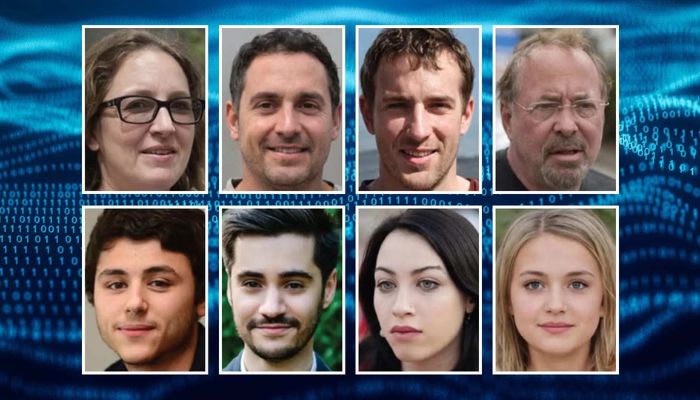
AI image creators have quickly advanced, now skilled at crafting faces that are deemed to be even more lifelike than actual ones.
Yet, recent research offers insight into enhancing our AI-face detection capabilities.
Scientists from the UK evaluated the face-recognition skills of 664 individuals, including super-recognisers (known for their expertise in comparing and identifying real faces in former studies), alongside those with average face-recognition abilities.
Both groups struggled with detecting AI faces, although, as anticipated, the super-recognisers performed better.
Notably, participants recognised as super-recognisers who underwent a short 5-minute training session before testing were more adept at distinguishing genuine faces from AI-generated ones.
"AI-generated pictures are becoming easier to produce and harder to identify," says psychology expert Eilidh Noyes, from the University of Leeds.
"They are capable of being misused, so it's crucial from a security standpoint that we explore methods for detecting synthetic images."
The research comprised two different activities, conducted with and without prior training. In the first task, participants were shown a single face and asked to decide whether it was AI-made; in the second, they saw a real and an AI face side by side, tasked with spotting the counterfeit.
Each experiment involved a different set of participants.
For the group without training, super-recognisers correctly identified AI faces 41 per cent of the time, whereas individuals with regular face-recognition abilities detected AI faces only 31 per cent of the time.
Considering half the images were AI-produced, participants had a 50 per cent chance of guessing accurately, illustrating further that AI portraits often look more genuine than reality to us.
In the group that received training, those with standard recognition skills spotted AI with 51 per cent accuracy, akin to random guessing.
Meanwhile, the super-recognisers improved their accuracy to 64 per cent, effectively identifying the AI faces with high precision.
The volunteers were taught to detect certain signals indicating a face may be created by AI, such as missing teeth and odd blurs around hair and skin edges.
"Our findings suggest using super-recognisers – individuals with exceptional face recognition prowess – along with training could assist in identifying AI faces," says Noyes.
AI generally creates faces via a generative adversarial network (GAN). This involves two algorithm sets working collaboratively: one to craft faces, another to compare their authenticity against real people.
Such a feedback system pushes the image generator to produce highly convincing results.
Now capable of swift and easy production, AI images are increasingly used in various media types, from deceptive dating profiles to identity-theft schemes. Training might enable more individuals to avoid deception.
"Our training strategy is concise and simple to execute," says Katie Grey, a psychology researcher at the University of Reading.
"The outcomes indicate that pairing this training with the inherent skills of super-recognisers might address real-world challenges, such as online identity verification."
The findings have been published in Royal Society Open Science.


